
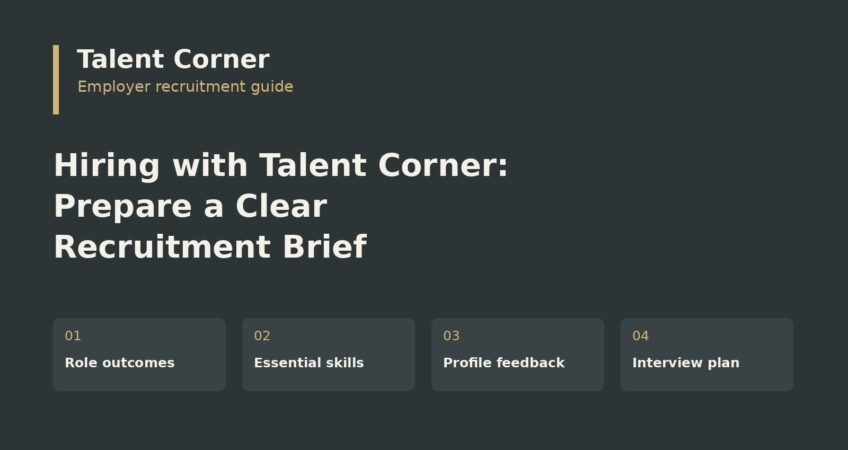
Hiring with Talent Corner: Prepare a Clear Recruitment Brief
A recruitment conversation is easier to use when the employer can explain the vacancy clearly. A job title alone rarely tells a recruiter what the person must achieve, which requirements are essential or who will make the final decision. Before approaching Talent Corner, prepare a brief that connects the role to the work your business needs done.
Talent Corner presents Executive Recruitment, Campus Recruitment and CXO Search among its services. This guide focuses on the employer side of that relationship: preparing a requirement, discussing the search, reviewing profiles and keeping decisions consistent. It is a practical briefing method, not a promise about placements, hiring speed or the terms of a particular engagement.
Quick answer: what should an employer prepare?
Prepare the business reason for the hire, expected responsibilities, essential skills, work location, compensation parameters and interview decision process. Separate confirmed facts from points still awaiting approval. Ask Talent Corner to explain the proposed service and confirm the scope, commercial terms and next steps in writing before work begins.
Keep the brief useful rather than long. A clear description of the work, supported by a few examples, gives the discussion a better starting point than an ambitious list of every skill the team might eventually need. The aim is to remove avoidable ambiguity before candidates are introduced, while leaving room for the recruiter to ask questions.
Begin with the work the new employee must own
Explain why the vacancy exists. Is the business replacing a departing employee, adding capacity or creating a responsibility that nobody currently owns? Describe the outcome you need without identifying confidential customers or sharing internal records that are not necessary for the enquiry. A recruiter needs enough context to understand the requirement, not unrestricted access to the business.
Translate the outcome into actual responsibilities. For a sales role, explain the type of customer conversation and internal coordination involved rather than asking only for a dynamic salesperson. For an operations role, identify the process the employee will manage and the problems they will be expected to handle. These are illustrative ways to describe work, not a statement about a current Talent Corner mandate.
Also explain the reporting line and the team around the position. A role that has a manager available for training differs from one that must work independently from the start. Make those conditions visible. If the role is new, say which responsibilities are settled and which still need an internal decision before a search can be meaningfully discussed.
Match the enquiry to the relevant Talent Corner service
Talent Corner lists Executive Recruitment, Campus Recruitment and CXO Search on its official services page. Explain the level and nature of the vacancy, then ask the team which service it proposes. Do not assume that a broad service name answers every question about the search, the assessment or the people who will be involved.
A graduate hiring discussion needs clarity about the work, training environment and selection process. An experienced specialist role needs a different account of practical experience and independence. A leadership discussion needs clarity about decision authority, reporting relationships and the business problem. These briefing differences help you ask more useful questions without suggesting that any service guarantees a particular result.
Keep the employer enquiry separate from a franchise enquiry. Talent Corner also offers a recruitment franchise, but buying recruitment support for your company and exploring a business opportunity are different decisions. Use the correct enquiry route and ask for documents relevant to that relationship. Do not combine franchise investment discussions with the scope of an employer hiring assignment.
Separate essential requirements from preferences
For each requirement, ask what would become difficult if the person did not have it on their first day. An essential qualification, a practical skill used every day and familiarity with an optional tool should not all carry the same weight. Tell the recruiter which points are fixed and which can be discussed after seeing the available experience.
Describe how you will recognise the skill. Instead of asking for excellent communication, explain whether the employee must write reports, explain a product to customers or coordinate technical questions between teams. Instead of requesting leadership, explain the team decisions the role will own. This makes later profile discussions less dependent on impressions.
Avoid turning the previous employee into an impossible template. Review which parts of the old role are still needed and which have changed. A replacement may join a different team or use a different process. If an internal stakeholder insists on a requirement, record the business reason so that the search conversation can address the actual constraint rather than a habit.
Confirm location, working arrangements and compensation boundaries
State the work location and the arrangement the business is prepared to offer. If travel, shifts or on-site attendance matter, describe them clearly and have the relevant internal person confirm the position. Do not tell a recruiter that flexibility is available when it has not been approved. Candidates need an accurate account of the role they are considering.
Have the compensation discussion internally before expecting a recruiter to present the opportunity accurately. Explain the approved range or the process for setting it, and distinguish fixed pay from components that need a separate explanation. This article does not provide salary benchmarks or advise a particular package. The objective is consistency between the brief and the eventual offer.
If a boundary is still open, mark it as open. For example, the reporting manager may be willing to discuss experience in place of a preferred qualification, while the work location is fixed. Explicit uncertainty is more useful than a confident answer that changes after interviews. Ask how updates to these conditions should be communicated during the assignment.
Agree what a useful candidate profile should explain
Ask Talent Corner what information it will provide with a proposed profile and what information your hiring team needs to make an interview decision. Focus on experience relevant to the brief, the questions still open and the practical arrangements that need checking. Do not assume that receiving a CV means every statement has been independently verified.
A useful internal review note links the candidate to the role. It might identify the relevant type of work, a skill requiring further discussion and a question for the interview. Keep that note factual and limited to hiring needs. Avoid collecting unnecessary personal details or circulating candidate information to people who have no role in the decision.
Clarify who performs any verification or assessment required by your organisation. Ask what is included in the proposed service and what remains the employer responsibility or requires another provider. A general recruitment description should not be treated as a completed background check, a technical assessment or a legal opinion about a candidate.
Give profile feedback that helps the next discussion
When a profile does not fit, explain the mismatch against the agreed brief. Experience with a different customer group is more actionable than not suitable. A missing example of a required skill is more useful than weak profile. Clear feedback gives the recruiter something specific to discuss and helps your own team notice when its criteria are changing.
Use the same core criteria across candidates. If a new concern appears during interviews, decide whether it is genuinely essential to the role and update the brief if needed. Do not apply an unspoken requirement only to the next person. Keep a record of the decision so that the hiring manager and the recruitment contact are working from the same version.
Ask how to handle disagreements between interviewers. An interviewer who values immediate technical independence may reach a different conclusion from one who expects to provide training. Resolve that difference inside the hiring team rather than sending contradictory instructions. Recruitment feedback works better when the employer has one clear position on the role.
Plan interviews around the decision you need to make
Identify the interview stages and who owns each decision. Discuss which questions will be covered at each stage so candidates are not asked to repeat the same conversation without a reason. Tell the recruitment contact when an additional assessment or interviewer is proposed, rather than changing the process after a candidate has already made arrangements.
Prepare role-related questions and a consistent way to record answers. For a practical exercise, explain its purpose, expected effort and how the response will be assessed. Follow your organisation policies and obtain appropriate advice where needed. This guide does not set employment-law requirements or claim that one interview design is right for every vacancy.
Give realistic availability for interviews and feedback. A preferred timetable is not a guaranteed hiring deadline. If a decision-maker becomes unavailable, tell the recruitment contact promptly and agree the revised next step. Keeping expectations accurate is more useful than announcing an aggressive schedule that the employer cannot support.
Put commercial and service expectations in writing
Ask for the proposed scope, fees, payment trigger and applicable conditions before accepting an engagement. If replacement support is discussed, request the relevant period, eligibility, exclusions and remedy in the actual agreement. Do not infer a guarantee from an informal conversation or from a fee mentioned in an older article.
Also ask which activities are included, who coordinates the assignment and how changes will be handled. A search for one defined role should not silently become a different assignment after the brief changes. Keep the quote and the agreed brief together so that later questions can be answered from the same record.
This article deliberately gives no market fee range, guaranteed closure time or promised replacement outcome. Those details belong in the current proposal for the particular requirement. Read the terms and ask questions before approving them. Where a clause has legal or financial implications you do not understand, obtain appropriate independent advice.
Use a short review to keep the requirement current
During a search, review the evidence rather than counting CVs alone. Are profiles relevant to the agreed work? Are interviews answering the questions the hiring team needs answered? Have salary, location or approval constraints changed? Discuss the underlying issue instead of assuming that more profiles will solve a brief that no longer reflects the vacancy.
Keep review measures proportionate to the assignment and agree their meaning with the recruitment contact. A profile, an interview and an offer are different events. This guide does not impose a reporting product or service level on Talent Corner. Ask what reporting is available and settle the arrangements that fit the actual engagement.
If the role is paused, filled internally or materially changed, communicate that clearly. Confirm the position on open profiles and any outstanding actions under the agreement. A current record protects the working relationship and avoids inviting candidates into a process the employer is no longer ready to continue.
Starting an employer enquiry with Talent Corner
Use the official Talent Corner contact page and describe the requirement in a concise brief. Include the role, business purpose, location, confirmed essentials, interview owner and questions about the proposed service. Avoid putting confidential candidate files, account credentials or unrelated company records into an initial public enquiry.
The useful next step is a discussion of your actual requirement and the scope Talent Corner proposes, not an assumption that every vacancy will be filled. Keep the original brief, revised versions, commercial terms and agreed actions together. This gives both the employer and the recruitment contact a clearer basis for the next conversation.
Frequently asked questions
What should I prepare before contacting Talent Corner?
Prepare the role purpose, main responsibilities, essential skills, work location, compensation boundaries and interview decision process. Mark unresolved points clearly and ask what further information the team needs.
Which Talent Corner service should I ask about?
The official website lists Executive Recruitment, Campus Recruitment and CXO Search. Explain the level and nature of the vacancy and ask the team to confirm its proposed service and scope.
Can an employer brief include flexible requirements?
Yes. Separate fixed requirements from preferences and points that need discussion. Explain why each essential requirement matters to the work, rather than giving every preference the same importance.
Does receiving a CV mean every detail has been verified?
Do not assume that. Ask what screening or verification is included, what questions remain open and which checks the employer must arrange or complete under its own process.
Are fees or a hiring deadline fixed by this guide?
No. Request the current written proposal for your requirement, including fees, payment conditions, scope and any replacement terms. A planning timetable is not a placement guarantee.
Is this the same as applying for a Talent Corner franchise?
No. An employer recruitment enquiry concerns hiring for your business. A franchise enquiry concerns operating a recruitment business under a separate commercial relationship. Use the appropriate route for the decision you are making.
