
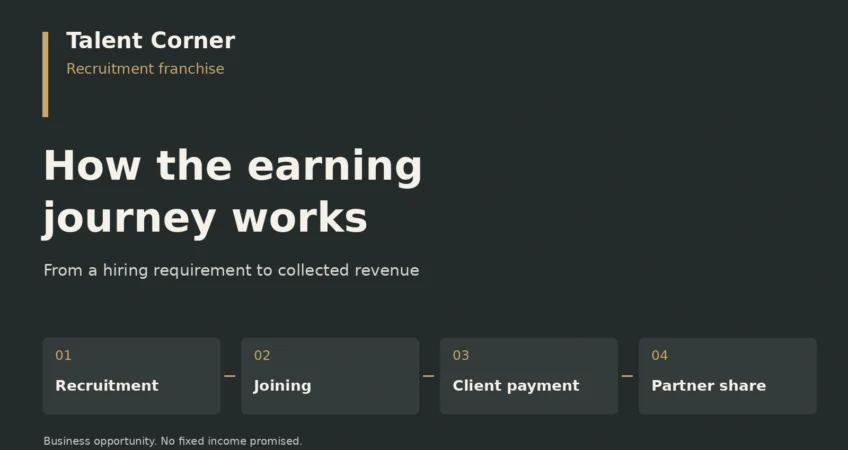
How Earning Through a Talent Corner Recruitment Franchise Works
A recruitment franchise can be a way to build a business around helping employers hire. The earning opportunity comes from recruitment work that leads to a placement and a service fee, not from simply signing up, receiving a job requirement or sending a CV. Understanding that distinction is a useful first step for anyone exploring Talent Corner’s franchise opportunity in India.
Talent Corner’s model separates Head Office support from the partner’s day-to-day recruitment responsibilities. This guide follows the commercial journey from a hiring requirement to a payment, explains what needs to happen along the way and helps you prepare for a practical franchise discussion. It does not promise a monthly income, a number of placements or a return on investment.
How the Talent Corner Franchise Earning Model Works
The Talent Corner franchise FAQs describe a business with three parts: administration, business development and operations. Head Office handles contracts, tax-related documentation, invoicing and payment follow-ups. It is also responsible for providing job requirements for partners to execute. Recruitment and client servicing are the partner’s core responsibilities.
The earning model is connected to that work. A partner helps move a hiring requirement through sourcing, screening, client coordination and the recruitment process. The published FAQs explain that Talent Corner charges the hiring company a service fee and shares that fee with the franchise partner under its commercial arrangement. A requirement is therefore an opportunity to work, not money already earned.
Before deciding, ask the franchise team to explain the current agreement in writing. Understand the events that make a fee payable, how the partner’s share is determined and which conditions or deductions apply. Use the written terms for your decision rather than treating a blog as a contract.
Start With a Clear Hiring Requirement
A useful recruitment assignment begins with understanding what the employer needs. A job title on its own rarely tells the whole story. Skills, experience, work location, responsibilities and the employer’s selection process all affect which candidates are suitable.
As a practical working habit, prepare a short requirement note before beginning candidate conversations. Record what is confirmed, what remains unclear and which questions need an answer. Ask about essential skills separately from preferences. Clarify how interview feedback will be shared and who should receive updates. These are ways to organise your work, not promises about a particular assignment or Talent Corner’s internal procedures.
A clearer brief helps you explain the role accurately and avoid asking a candidate to pursue an opportunity that does not fit. It also gives you a basis for discussing progress with the client. Sending more profiles without resolving an unclear requirement is not the same as moving a placement forward.
Turn Candidate Conversations Into a Relevant Shortlist
Talent Corner identifies sourcing, screening and shortlisting as recruitment operations covered in its onboarding. In practice, the purpose of a shortlist is to help the employer assess relevant people, rather than receive an unfiltered pile of CVs.
For your own working checklist, consider the evidence for each candidate’s fit. What experience relates to the role? Is the location workable? What information has the candidate confirmed, and what still needs checking? Keep notes factual. Do not describe an assumption as a qualification or promise an interview outcome that you do not control.
Candidate communication also matters. Explain the opportunity using confirmed information, listen to questions and record the next agreed step. A candidate who understands the role can make a more informed decision about continuing. Recruitment remains a process involving the employer and the candidate; a promising conversation is not a completed placement.
Keep the Process Moving Beyond the First CV
After a shortlist is shared, the work may involve arranging conversations, following up for feedback and helping both sides understand the next step. Talent Corner’s published model places client servicing alongside recruitment, so prospective partners should consider whether they enjoy sustained communication as well as identifying profiles.
A simple action log can make this work easier to follow. For each active requirement, note the latest confirmed stage, the person who needs to respond and the next follow-up. If feedback changes the requirement, update your notes before continuing the search. This is a suggested organisational approach, not a description of a mandatory company template.
Do not count every interview as a likely payment. Employers can change their needs, candidates can decide not to continue and a selected candidate may still have steps to complete before joining. Recognising these possibilities helps you give accurate updates without presenting uncertainty as certainty.
Separate Selection, Joining, Invoicing and Collection
The most important financial distinction is between progress in recruitment and money received. A candidate being shortlisted, interviewed or selected does not mean that client payment has already reached Talent Corner or that the partner’s share is ready to transfer.
The current FAQs describe client payment as generally expected within 30-45 days after the candidate joins, while noting that clients may pay later. They state that the partner’s share is transferred within seven days of Talent Corner receiving the client payment. These are the company’s published descriptions of the cycle, not a guarantee that every assignment will produce money on a particular date.
Ask the team to walk through the actual sequence under the proposed agreement. Confirm what documentation is needed, when invoicing can happen, how payment status is communicated and what applies if a placement does not continue. Leave room for collection delays in your own cash planning instead of relying on an interview date or an expected joining date.
Understand Revenue Share Without Confusing It With Take-Home Profit
The franchise FAQs currently state a 70% partner share and a 30% royalty share of the service fee. They also describe a standard service-fee basis, while acknowledging that some situations may have different rates. Confirm the terms applicable to your participation directly with Talent Corner before making a decision.
A revenue share is not automatically the amount left for personal use. The FAQs say applicable taxes and deductions can affect the partner’s share, and operating a business also involves expenses. Keep the service fee, the partner’s share, money actually received and the costs you pay as separate items in your records.
This guide does not multiply an assumed salary by a fee rate and call the result your expected monthly income. Such an illustration can hide the uncertainty of closures, joining, collections and costs. A more useful discussion is how the written commercial arrangement applies to a real assignment and how you will track it.
Plan for the Costs of Running the Business
Talent Corner’s FAQs describe an upfront franchise fee, job-portal subscriptions and practical requirements such as a computer, internet connection, telephone, time and effort. The published model allows operation from home, but that does not mean participation has no costs.
Request a current written cost breakdown from the franchise team. Separate one-time payments from recurring expenses, ask what is included and confirm what you must arrange yourself. If you intend to hire someone, include that responsibility in your discussion: the FAQs say salaries for employees hired by a partner are the partner’s responsibility.
For personal planning, compare expenses with cash received rather than with the value of open requirements. Consider how you would meet ongoing costs while work is in progress or a client payment is delayed. This is a planning exercise, not a recommended investment amount or a forecast of when the business will recover its costs.
A Small Tracking Sheet for the Earning Journey
You can make a franchise conversation more useful by bringing a simple proposed tracking sheet. Its purpose is to show what you want to understand about the work and money cycle. Confirm how it should fit Talent Corner’s actual systems before using it operationally.
- Requirement: the role, confirmed expectations and questions still awaiting answers.
- Recruitment stage: sourcing, shortlist, interview, selection or another stage confirmed by the team.
- Next action: what needs to happen, who is handling it and the agreed follow-up.
- Joining: the confirmed joining information, kept separate from an offer or an intention to join.
- Commercial status: invoicing and collection information confirmed by Head Office, not an assumed receipt.
- Partner payment and expenses: money actually received and the costs paid, with supporting records.
This approach keeps effort, progress and cash visible without treating them as interchangeable. It can also help you ask more precise questions when something is delayed. Use the company’s agreed process for records and candidate information rather than creating a separate store of unnecessary personal data.
Check Whether the Work Fits Your Day
Before focusing on earnings, picture the ordinary working day. Can you make time for a candidate conversation, respond to a client question and return to a pending follow-up? Can you keep working on a requirement when the first shortlist does not lead to a selection? These questions test your readiness for the activity behind the opportunity.
Write down the hours you can realistically give, the equipment you already have and the support you would need to learn recruitment. Take that note to the franchise discussion. Talent Corner’s FAQs describe both part-time and full-time participation, but your availability should be discussed in relation to actual responsibilities. An arrangement that fits your calendar still needs your attention, and an active day does not necessarily produce an immediate payment.
What to Ask Talent Corner Before You Begin
The Talent Corner franchise enquiry page offers a callback route for people considering the opportunity. Prepare questions around your own circumstances and the current agreement, rather than asking only how much you could earn.
- What recruitment and client-servicing work will I personally handle?
- How will requirements be allocated, and how should I raise questions about a brief?
- Which events make the service fee payable under the applicable terms?
- How are the partner share, deductions and collection updates communicated?
- What happens if a candidate does not join or leaves after joining?
- Which costs are included in the franchise arrangement and which are my responsibility?
- How do payment delays, discontinuation and other conditions work in the written agreement?
For the separate question of onboarding and ongoing support, read the Talent Corner training, workflow and support guide. Keep that support discussion connected to the work you expect to carry out, but do not treat support as a promise of earnings.
Frequently Asked Questions
Can I start earning simply by joining the franchise?
Joining gives you a business opportunity to explore and operate under the agreed model. It does not create a fixed income. Recruitment work, placement outcomes, the service-fee conditions and receipt of client payment matter to the earning journey.
Does a job requirement guarantee a placement?
No. A requirement is work to execute. Candidate suitability, interviews, selection and joining still have to progress. Discuss allocation and responsibilities with Talent Corner without assuming that every requirement becomes a fee.
Who handles invoicing and payment follow-ups?
The current franchise FAQs assign contracts, tax-related documentation, invoicing and payment follow-ups to Head Office. Ask how partners receive updates and what information they must provide to support that process.
Is the partner’s share the same as profit?
No. The published revenue share concerns the service fee. Applicable taxes, deductions and your business expenses need separate consideration. Confirm the current terms and seek professional advice for questions about your own accounting or taxes.
Is there a fixed monthly income or guaranteed break-even period?
Talent Corner’s FAQs state that earnings depend on performance and results and that this is a business opportunity, not a salaried job. This article makes no fixed-income or break-even promise.
What is a useful first step?
Read the official franchise FAQs, note your available time and prepare questions about responsibilities, costs and the payment cycle. Request a callback through the franchise enquiry page and review the current written terms before making a commitment.
Build Your Decision Around the Actual Work
The practical route to earning through a Talent Corner recruitment franchise is to understand the requirement, carry out recruitment and client servicing, support the placement process and follow the agreed commercial cycle. Training and Head Office support help define the model, while your involvement in the work remains important.
Start with a clear view of the responsibilities and the difference between a live requirement, a placement and collected revenue. Then discuss the opportunity with Talent Corner using current written information. That gives you a better basis for deciding whether the business suits you than an income headline alone.
